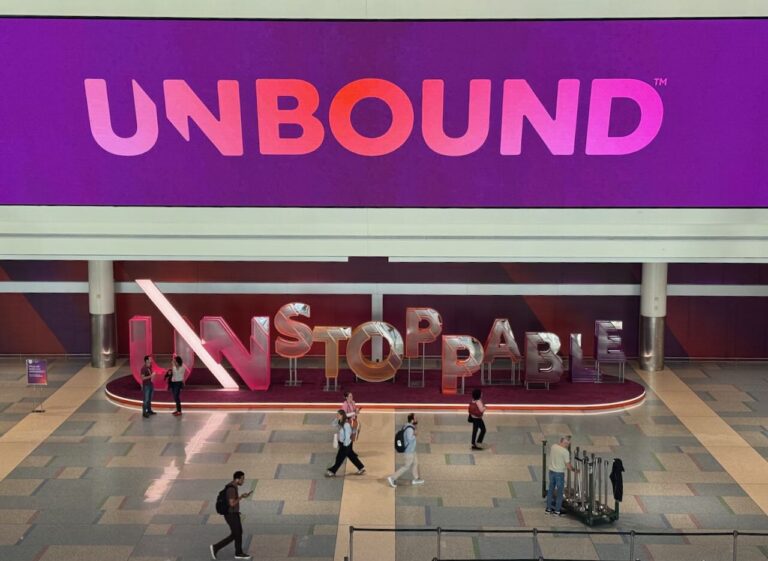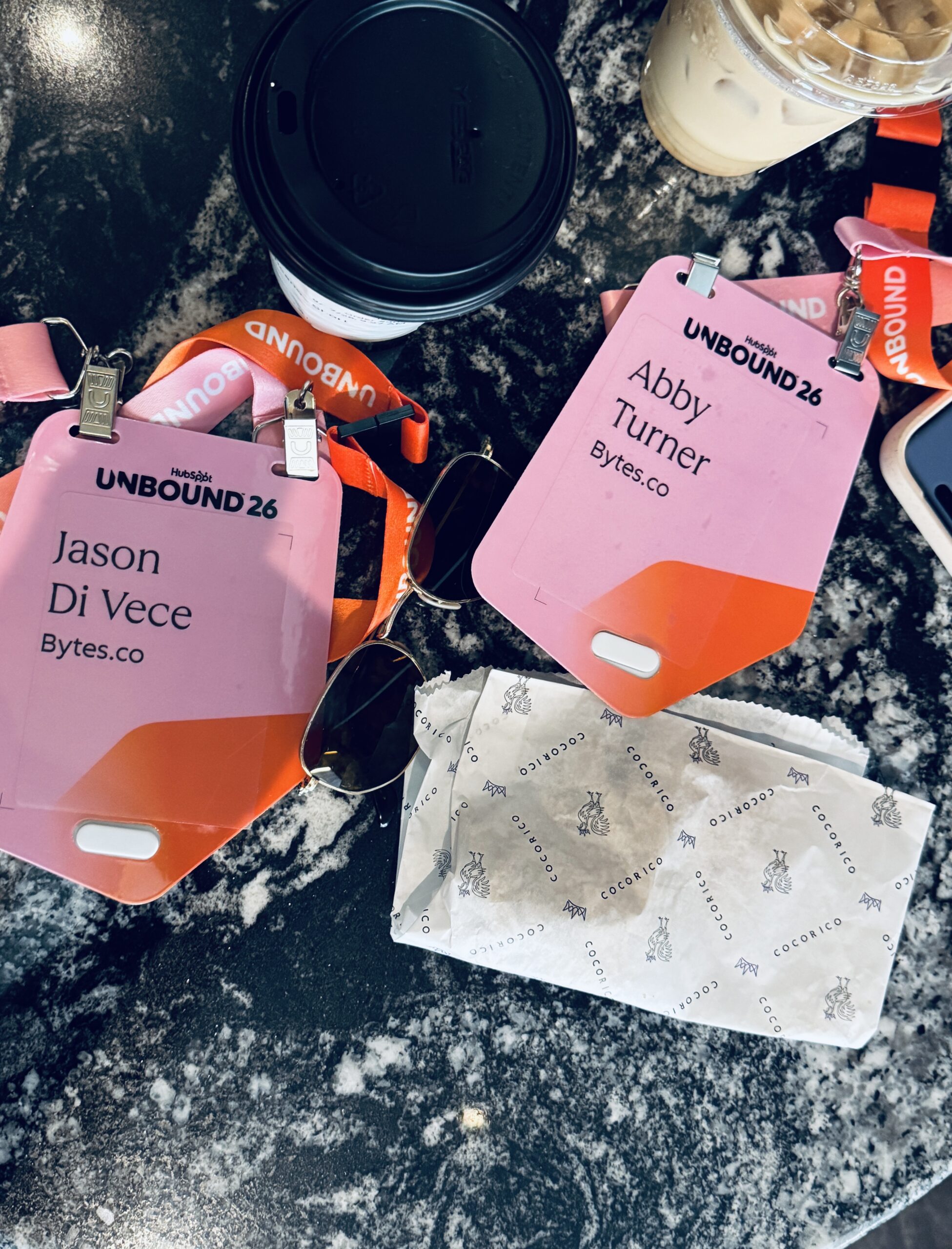

21,500 steps later, I was back in my hotel room ready to sort a sub-reddit by the top comments of all time to find my product / market fit. All this AI for how to solve your problems, and the message I heard on repeat was: be human first.

Being surrounded by so many people, do you ever worry about germs? I don’t, but people do. Today was all about the exhibition floor. No sessions. Just me and my black sling bag walking around with Abby and meeting people at the booths, at the coffee bar or in one of the many lounge areas. First stop PandaDoc, the software behind every proposal Bytes.co has written since 2018. And wouldn’t you know it, they had hand-spray sanitizer for swag.
I didn’t expect the three-letter abbreviations to be this aggressive at UNBOUND…. CLM, ABM, DSP, CPG, CPA, MCP, ILM, ICP, CAM, AEO, GEO, GTM, PSA. We have an obscure, in-group language I find ridiculous, but am guilty of perpetuating it. All day the acronyms poured like alphabet soup.
“Tell me more about the CLM product and why we need it.”
“How is your PSA working out?”
“What’s your ICP and how does the CRM support the ILM?”
After discussing CPQ with the team at PandaDoc, Abby and I ventured over to Webflow, a leading platform in the world of “no code” development. The company had a rocky start and nearly crashed, but last year secured 140 million in Series B funding. While their market share is still small compared to other CMS out there, they’ve grown considerably over the last few years with adoption being concentrated on highly-trafficked, popular sites. It comes up more and more in conversations I have with prospects that are looking to re platform their website, or find new Agency support.
I asked the booth rep with unusually fashionable eyewear, “How are you becoming more popular these days?”
They responded, unequivocally. “By being awesome.”
Is Webflow actually awesome as a visual development platform in 2026? I’ll have to give the tool a second look.
We continued to wander wide-eyed amongst the spectacle until landing at Chili Piper, a B2B meeting lifecycle platform with intelligent lead qualification and rule-based routing to SDRs. Like Calendly, but better! Would this be good for a large real estate group needing ICP rules applied to support a legacy ILM as they migrate to a new CRM? They thought so, but weren’t totally sure if they had any case studies or examples in that industry. I scanned the QR code to get a free bottle of “for humans only” hot sauce and walked on.
Lastly, I’ll mention the HubSpot booth, if you could even call it a booth. A small village really, complete with a demo area for every “hub” and plenty of coffee nearby to keep the bees buzzing. At Abby’s behest, I took a demo of Service Hub; HubSpot’s CSM that’s BFFs with their CRM complete with built in SLA and CSAT. Honestly an impressive looking product, but at $100 per user per month, pretty expensive compared to our current solution with ZenDesk.
Siloed data means you are constantly having to prove the value of your work. What you need is trusted, unified marketing data, with a statistical model for customer lifetime value. You need — [insert domain.ai]!
There is actually an AI company for everything now. Woven throughout the various value-propositions is the promise of a solution to an underlying hurdle facing so many of us right now: an undefined or fragmented data layer paired with legacy workflows. Together, they make AI adoption harder to operationalize and the outputs less useful.
Fragmented though it may be, your operational data is a key part of what makes you special, and a lot of us may not even have that for much longer. Just this morning, I got an email from someone @lumorelo.com offering to pay $100k+ in exchange for Bytes.co’s “anonymized records from software for AI companies”. I suspect they aren’t looking to wholesale purchase our data because it’s dark magic, but instead are interested because it’s ours and therefore not already in every other model’s training set or knowledge graph. The value is scarcity and provenance, not sophistication.
But the gold medal today for the most widely mentioned acronym on my talk track goes to AEO: Answer Engine Optimization. As marketers, we seem to be in a bit of an AEO arms race right now. How do you become the specific trusted source, summary, or citation inside an AI-generated response? More importantly, how do you track the results when you are that trusted source? Everyone seems to be trying to put a box around this circle, but few I heard from or spoke with seemed to agree (or even know) how big this circle is.
Reliably measuring the ROI of AEO is a different kind of statistical thinking compared to traditional SEO. The average word count on a Google query is 3 to 5. For ChatGPT, it’s 23. There’s also the matter of AI searches being non-deterministic. AI engines dynamically generate responses on the fly, making single-prompt checks unreliable. The exact same prompt can result in different answers or brand mentions depending on context, phrasing, and model. Everyone does agree that being discoverable by AI search is crucial right now as AI adoption is spreading at a historic pace.
Where can you start when it comes to AEO? The first thing, figure out what prompts you want to track. To do that, learn from your customers. What are they asking you?? You can also (CTA alert) contact Bytes.co!